Online Lecture | Factory Made: The Industrial Spaces of Gustav Stickley
Join us for “Anti-domestic: An Alternative Architectural History of Gustav Stickley,” a six-part online lecture series!
Led by Dr. Willa Granger, our new Curator of Education and Collections, this series will consider the broader architectural history of Gustav Stickley, exploring the diverse spaces and places that facilitated his entrepreneurship. We will examine and hypothesize about how Stickley existed in, reacted to, and shaped buildings ranging from the furniture shop at Auburn State Prison to his factory in Syracuse and his tall building in Manhattan, down to the very infrastructure—train networks, lumberyards, and beyond—that enabled the Craftsman vision. In telling this alternative architectural history, we can better understand the man, positioning him less exclusively as a visionary Arts and Crafts crusader and more as a businessman and property owner navigating the complex and contradictory terrain of Progressive-era America.
Lectures may be purchased individually or as a complete series. Click here for the full course description.
Lecture 2
Factory Made: The Industrial Spaces of Gustav Stickley
Sat., October 17, 2026, at 1:00 P.M. EDT
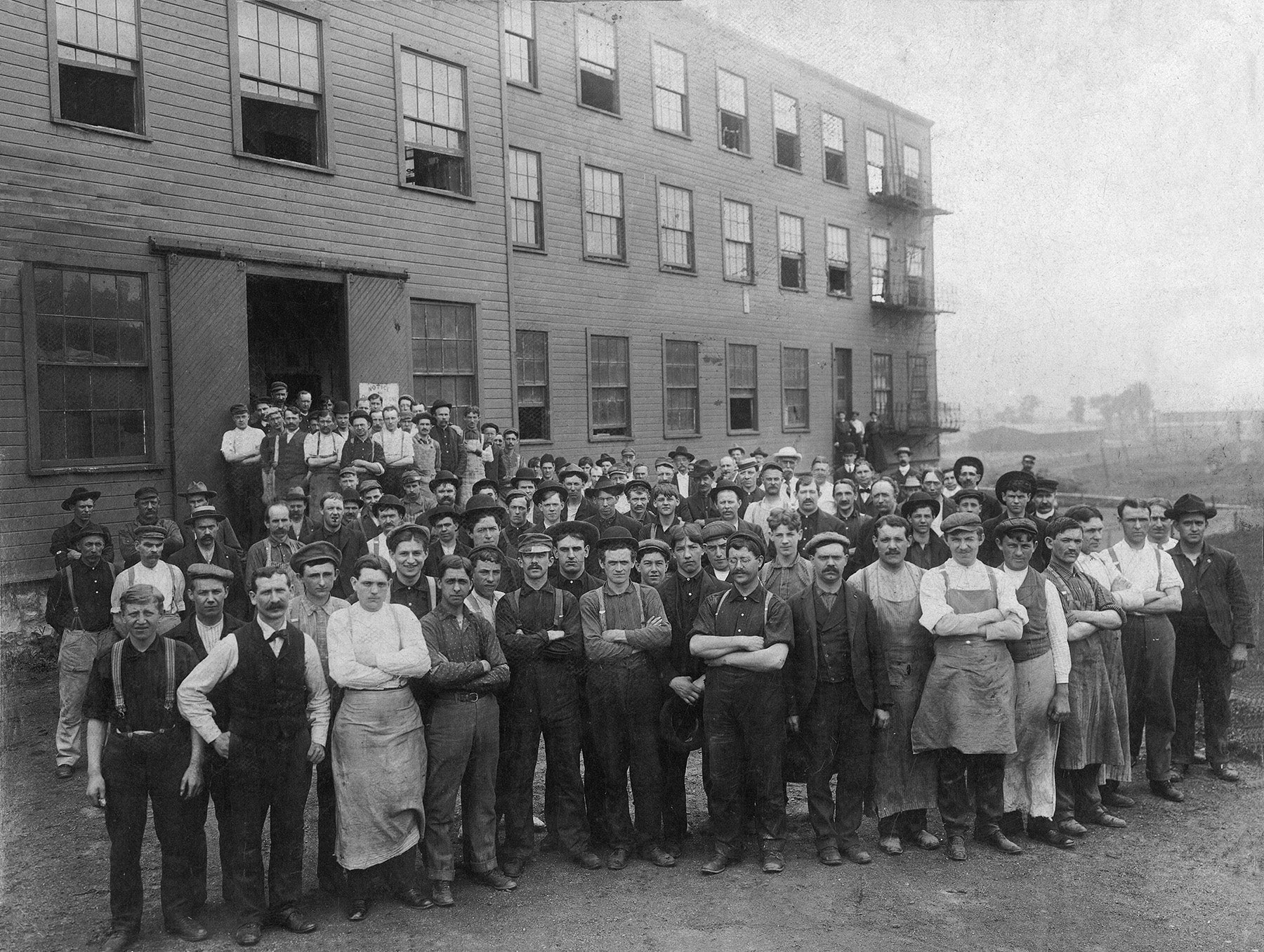
Factories, the visual antithesis of domesticity and handcraft, were fundamental to Stickley’s lifework and development. Although Stickley nostalgically billed himself as a “farmer boy,” he began working at his uncle’s chair factory as early as age seventeen and eventually transitioned to manager. By 1892, Stickley had commissioned his own factory building in the Eastwood section of Syracuse. Much has been written about the objects produced in this building, but what about the structure itself and the workers therein? Further still: what about the tools that made the furniture, mechanized or not? The optimal layout of workstations and workers was of course essential to the scientific management of modern manufacturing, but to what degree did Stickley participate in that culture when envisioning this building, and to what degree did he reject it? This lecture pursues Stickley’s paradoxical relationship to factories, a building form synonymous with industrialization, yet one he often billed as his “workshop.” Together, we will look at the building itself as a tool engineered for modern manufacturing and at the larger property as a complex social ecosystem that reflected and determined the diverse lives of skilled and unskilled laborers in industrial America.
A La Carte
Member Price: $30 / session
Non-Member Price: $35 / session
Full Course
Member Price: All 6 sessions for $150 (one session free)
Non-Member Price: All 6 sessions for $210
Registration is required. Once registered and paid, you will receive an email prior to each session with a link to join.
Do you have a scheduling conflict for the live session? You can still enjoy the program. Register and we’ll send you the recording! All paid attendees will be emailed a private link to the session recording when it is available, typically 6-7 days after the live program.
Missed us? You can also register retroactively. If you register for a session that has passed, you’ll receive access to the recording when it is ready.
Haven’t tried a session yet? Each session is planned as a “stand-alone” lecture, so you can take them all or attend the topics that interest you most.
Date
- Oct 17 2026
- Expired!
Time
- 1:00 pm - 2:30 pm
Cost
- $35.00
More Info
Location
Category
Organizer
-
The Stickley Museum at Craftsman Farms
-
Phone
9735400311 -
Email
info@stickleymuseum.org -
Website
https://www.stickleymuseum.org/