COURSE DESCRIPTION:
I have been sitting here at my laptop intending to write a description for the above titled course in which we can debate the role and merits of the machine in contemporary life unaware that I was a portrait of that very irony. This class is about this problem–“what is the proper place of machines in modern life?”–because it is one which keeps surfacing. It doesn’t matter whether you are concerned about the role of AI today or a design reformer in 1900s Minneapolis; whether you were part of the rioting silkweavers in 1675 or a member of London’s Arts and Crafts Exhibition Society. Underlying all of these disparate events was a fundamental need to reconcile the potential of the machine with spiritual and emotional needs. At what point does our use of the machine start to erode our inherent humanity?
Writing in The Craftsman in November 1902, Oscar Lovell Triggs asked a question that is as relevant today as it was almost 124 years ago: “What is the relation of the machine to culture?” You might expect that in Stickley’s magazine–devoted as it was to the emerging Arts and Crafts movement–the machine’s impact on culture could only be detrimental, in keeping with the reactionary politics of Ruskin and Morris. Triggs, it seems, had other ideas:
We want machinery. We want more and ever more of it. But when machinery has done its work, when all our common and primitive needs are satisfied by quantitative production, when everything that is really mechanical in conduct is mechanicalized, then we escape into a transcendental sphere where the will is free, where conduct is vital every moment.
Using this quote as a springboard, these seminars will examine the fundamental question of our age–the relation of the machine to culture–and explore how it has evolved over time. We’ll think about the categories of craft vs. design vs. art to see if within these historical precedents there are lessons to be learned and strategies to be adopted. Readings from William Morris to Ernest Batchelder to Dieter Rams to David Pye will help center each week’s discussions and–in what’s a first for these classes–they’ll be linked for participants to have access to. Don’t want to read? Then don’t. The goal here is to provide different layers and levels of engagement depending on your schedule and your desire.
I’d like the Stickley Museum at Craftsman Farms to be a place that can have these important discussions, where we can talk about what design means and what ideally it can accomplish. What you’ll find in the session descriptions below is the broad arc of history we’ll cover–not as a comprehensive narrative but as moments to which we can drop in on, learn something from, and use in our own lives.
ABOUT THE INSTRUCTOR:
Dr. Jonathan Clancy has been the Executive Director at the Stickley Museum at Craftsman Farms since 2025 and on staff since 2020. Those interested in the Arts and Crafts field will know his publications including: The First Metal—Arts & Crafts Copper, These Humbler Metals: Arts and Crafts Metalwork from the Two Red Roses Foundation Collection, Beauty in Common Things: American Arts and Crafts Pottery from the Two Red Roses Foundation as well as articles for The Journal of Modern Craft, Style 1900 and Journal of Design History. Other contributions include chapters and articles on topics ranging from Studio pottery after World War II, American trompe l’oeil paintings of money, and John Singleton Copley’s Watson and the Shark. He is currently co-authoring a catalog on European ceramics for the St. Louis Art Museum and contributing to a planned exhibition on French ceramist Taxile Doat. His article on the ceramic collection of Gustav Stickley for the journal Ceramics in America was released earlier this year.
Summer Seminars 2026
Craft, Design, and the Machine in Modern Life
A La Carte
Member Price: $30 / session
Non-Member Price: $35 / session
Full Course
Member Price: All 6 sessions for $150 (one session free)
Non-Member Price: All 6 sessions for $210
Registration is required. Once registered and paid, you will receive an email prior to each session with a link to join.
Do you have a scheduling conflict for the live session? You can still enjoy the program. Register and we’ll send you the recording! All paid attendees will be emailed a private link to the session recording when it is available, typically 6-7 days after the live program.
Missed us? You can also register retroactively. If you register for a session that has passed, you’ll receive access to the recording when it is ready.
Haven’t tried a session yet? Each session is planned as a “stand-alone” lecture, so you can take them all or attend the topics that interest you most.
Week One
Craft, Machine, and Man (or Morris and the Making of Meaning)
Sat., June 20, 2026, at 1:00 P.M. EDT
“As a condition of life, production by machinery is altogether an evil; as an instrument for forcing on us better conditions of life it has been, and for some time yet will be, indispensable.” – William Morris, “The Revival of Handicraft,” 1888
“To distinguish between the different ways of carrying out an operation by classifying them as hand- or machine-work is, as we shall see, all but meaningless.”
– David Pye, The Nature and Art of Workmanship, 1968.
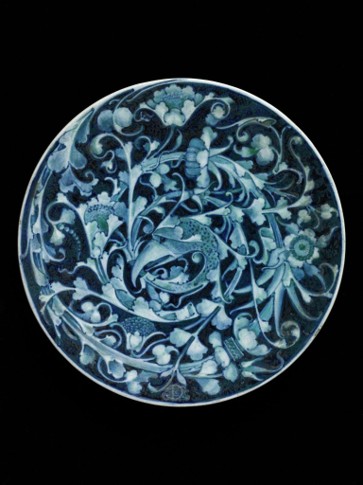
What we mean by craft–and indeed what we admire about examples of it–is often constrained by ideas we have about mechanization, the need for unity between artist and maker, and beliefs we have about what the Arts and Crafts movement meant to consumers and practitioners in the period. Even today, many frame William Morris as a kind of decorative Luddite to model oneself after, ignoring writings about the machine that are far more nuanced and complicated. In this session, we’ll think through the Arts and Crafts in England exploring the degree to which misunderstandings continue to shape our impression of it. And, we’ll learn to look with the critical eye of a maker like David Pye whose writings still form an important lens through which to think about craft, process, and materials.
Lewis Foreman Day, plate, 1877. V & A Museum.
Week Two
The Art and Crafts of the Machine
Sat., June 27, 2026, at 1:00 P.M. EDT
“The machine is intellect mastering the drudgery of earth that the plastic art may live; that the margin of leisure and strength by which man’s life upon the earth can be made beautiful, may immeasurably widen; its function ultimately to emancipate human expression!” – Frank Lloyd Wright
“To criticize the movement as being out of touch with modern thought is to misinterpret its best ideals. It seeks to bring a better standard to industrial work, establish a permanent demand for better things, and furnish an adequate livelihood for those who are competent to give beauty to hand work. It does not necessarily antagonize machinery, nor does it hope to achieve its ends through a reversion to primitive methods.” – Ernest Batchelder
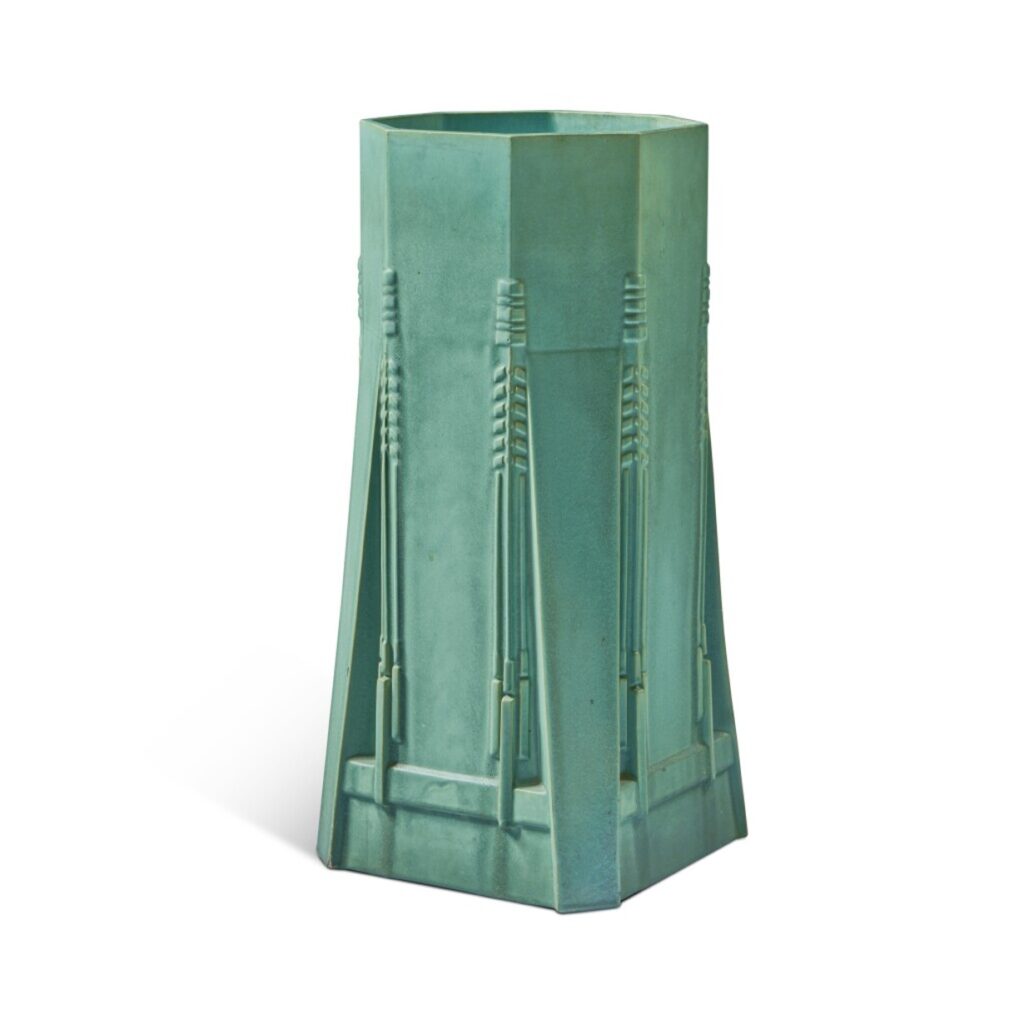
The deeper you dig into the Arts and Crafts movement, the more you will find that there is no single, satisfactory answer to the central question Triggs asked: What is the relation of the machine to culture? What we find instead is evidence of struggle, of complexity, of contradiction. It would be easy–and some have tried–to dismiss the movement and its makers as insincere if not altogether hypocritical simply because there are moments of misalignment between word and deed. Does every potter need to work in the manner of a George Ohr or a William Walley in order that we might find them consistent? Or, following the lead of Walt Whitman––”Do I contradict myself? / Very well then I contradict myself, / (I am large, I contain multitudes)––can we understand these contradictions as features rather than failures? In this session we’ll explore how aesthetics can reinforce and/or undermine the movement’s philosophical claims and think through the production of objects. We’ll explore why these claims–even as they were difficult to substantiate–had such a powerful draw for producers and consumers.
Frank Lloyd Wright for Gates Pottery, vase, ca. 1902. Sotheby’s
Week Three
Ornament and Crime or the Decorative Arts of Today
Sat., July 11, 2026, at 1:00 P.M. EDT
I have made the following discovery and I pass it on to the world: The evolution of culture is synonymous with the removal of ornament from utilitarian objects. I believed that with this discovery I was bringing joy to the world; it has not thanked me. – Adolph Loos, Ornament and Crime
I notice that a whole mass of objects which once bore the sense of truth have lost their content and are now no more than carcasses: I throw them out.
I will throw out everything from the past except that which is still of service to me. Some things are always of service: art. – Le Corbusier, The Decorative Art of Today
So easy has it become for us to focus on aesthetics as the defining feature of an object that we can miss the larger through lines that fundamentally connect objects that can look radically different. While Corbusier and Loos are not figures we often associate with craft, their texts reveal how–if read sensitively–they are the inheritors of an established tradition easily traced back through Batchelder and Wright to Morris and Ruskin. Framed in this manner European modernism and indeed the International Style are not radical ruptures of tradition but represent a refinement of many of ideas we have already covered. What is the role of the machine in the making of an object? To what degree is applied decoration consistent with simplicity and functionalism? What role should cost have in allowing a larger amount of people to surround themselves with better things? Perhaps most importantly, where does craft and design end and art begin?
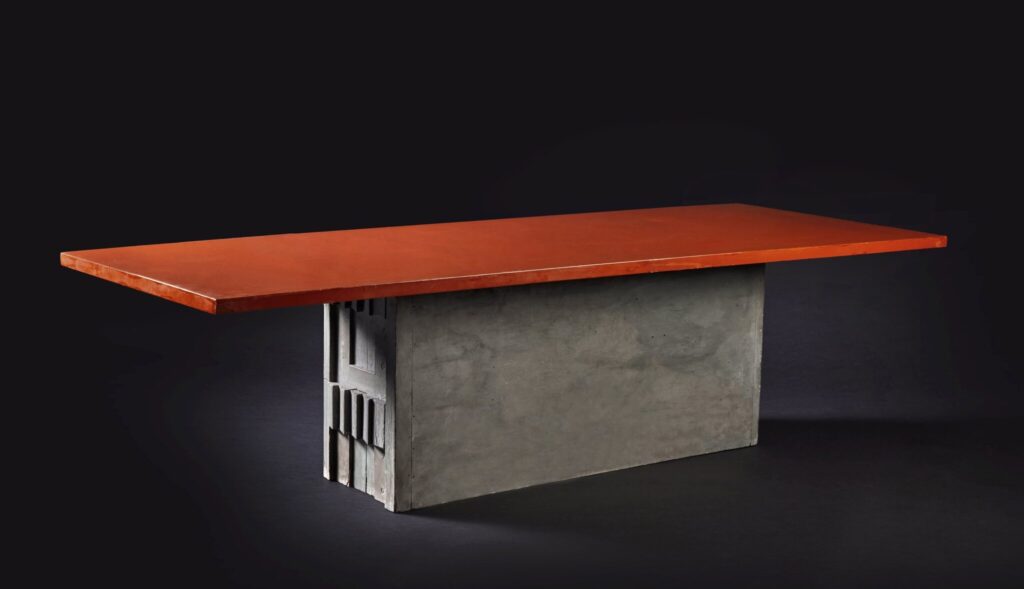
This session will embrace the diversity of modernisms–from Irish interior designer Eileen Gray to Argentinian Alberto Churba to Cuban-Born Clara Porset–rather than focusing exclusively on Europe and the United States.
Eileen Gray, table, ca. 1920s. Sotheby’s.
Week Four
The Spirit of the Machine and the Nature of Materials
Sat., July 18, 2026, at 1:00 P.M. EDT
We perceive that the person who would use a machine must be imbued with the spirit of the machine and comprehend the nature of his materials. We realize that he is creating the telltale environment that records what man truly is.
– Norman Bel Geddes, Horizons in Industrial Design (Boston: Little, Brown, and Company, 1932), 4.
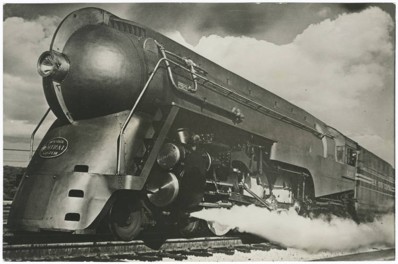
Ignore for a moment the question of style and Henry Dreyfuss’s streamliner locomotive transforms before your eyes. Here, in a single object lies the fulfillment of so many ideals–of form following function, of ornament that springs organically from the materials it is made from, of design being a true expression of its age–that generations of craftspeople had wrestled with since Morris’s time. Although it more than adequately illustrates Stickley’s observation that “the simple and the structural are a spontaneous expression of the times” it can feel foreign and distant from the realm of craft. It questions, quite forcefully, the degree to which the machine has wholly conquered the idea of craft and forces us to confront, as Triggs worried, “the relation of the machine to culture.” This session will explore streamlined design–through works by Bel Geddes, Dreyfus, Clarence Karstadt and others–and examine the manner in which it struck (or missed) an appropriate balance between the machine and humanity and what it might teach us about today.
Henry Dreyfus, Zephyr streamliner Locomotive,
Week Five
From Bauhaus to Braun (or Ten Principles for Good Design)
Sat., August 1, 2026, at 1:00 P.M. EDT
Good design is as little design as possible. The aim of design is by no means the sterile sparseness that I and other like-minded designers have been accused of producing. Instead, it is the freedom from the dominance of ‘things.’
– Dieter Rams, Less But Better (1995).
Back to purity, back to simplicity! – Dieter Rams, Less But Better (1995).
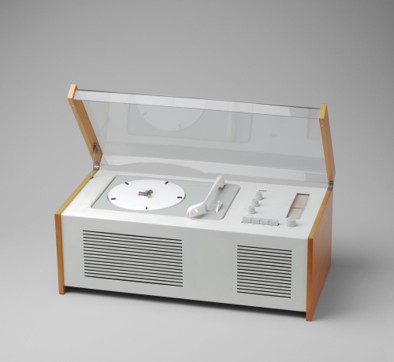
Finally codified in 1995 as his Ten Principles of Design, Dieter Rams’s approach to objects demonstrates a remarkable consistency with ideas that emerged in late 19th design reform. Simply put, Rams believed that design should make the world a better place. Inseparable from the aesthetic concerns for Rams were the ethical ones and he stressed design should be “environmentally friendly,” “durable,” “aesthetic,” and “useful.” Like the Victorian reformers a century before him, Rams wanted objects that did not compete for attention but brought about a sense of repose or what he called “a level of calm that allows people to return to themselves.” For Rams, the machine needed to be subservient to the human, helpful but unobtrusive, a means to assist rather than a source of frustration. This session will examine Rams’s work at Braun, using the ten principles of design as a guide and considering his impact even today. Additionally, we will think about the degree to which these principles are useful for objects of any period.
Dieter Rams and Hans Gugelot for Braun AG, Radio-Phonograph (model SK 4/10), 1956. MoMA.
Week Six
Our Evolving Craftsmen
Sat., August 8, 2026, at 1:00 P.M. EDT
Reading the literature of the Arts and Crafts movement and the thinking which generated it, reading the formulations of the ideal of living as expressed in publications of that time, the thought repeatedly and urgently recurred to us that many of today’s craftspeople whose work had been in our shows, and whom we had come to know, were, in fact, now living that ideal articulated at the turn of the century. – Eudora Moore, introduction to Craftsman Lifestyle: The Gentle Revolution (1976).
Writing nearly fifty years ago, Pasadena Art Museum curator Eudora Moore sensed a continuity between the ideals of the Arts and Crafts movement and contemporary design springing up in California. Rather than viewing mid-century modern as antithetical to craft–or indeed the inclusion of commercial manufacturers as a slight to craftspeople–the museum hosted triennial exhibitions called California Design from 1955-84 that cast a wide net that broadly welcomed good design. By refusing to participate in the craft vs. industry binary, the exhibitions preemptively undermined any claims regarding the hierarchies of craft or design or their fabrication. 1968’s California Design Ten, for instance, featured the pottery of Michael Frimkess alongside a DIY Manx dune buggy kit, Modeline of California light fixtures, Bob Mitchell wallpaper, macrame, applique work, and the jewelry of Arline Fisch. As we look back over the ideas proposed in each of the sessions, we’ll see that rather than finding an ideal solution to Triggs’s question that is universally applicable, each generation is continually negotiating the boundaries between self and machine and culture.
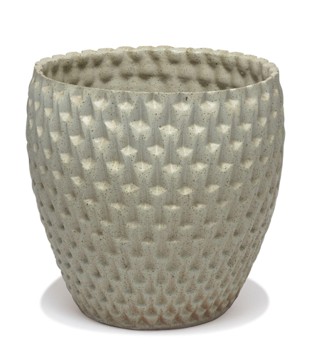
David Cressey for Architectural Pottery, planter, 1963. Wright.
A La Carte
Member Price: $30 / session
Non-Member Price: $35 / session
Full Course
Member Price: All 6 sessions for $150 (one session free)
Non-Member Price: All 6 sessions for $210
MORE INFORMATION